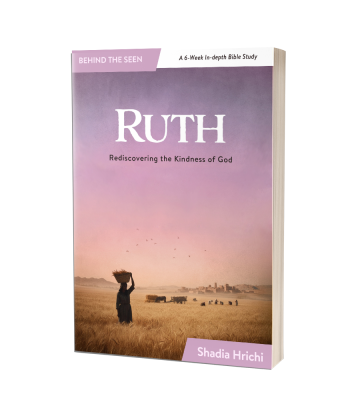
This excerpt is from RUTH: Rediscovering the Kindness of God! Order your copy today!
“Now Boaz said to Ruth at mealtime, ‘Come here, and eat of the bread, and dip your piece of bread in the vinegar.’ So she sat beside the reapers, and Boaz passed parched grain to her; and she ate and was satisfied.” – Ruth 2:14 (NKJV)
How Boaz Demonstrates Biblical Kindness and Compassion
Consider all that Ruth has endured in her life up to this point in the story: widowed, childless, a foreigner in a strange land. . . . Although Ruth is clearly a strong, resilient woman, she was also likely hungry, tired, feeling isolated and alone—ever aware of the risk of assault. Surely her heart hoped, even longed, to find a hint of compassion in someone’s eyes. When she encounters Boaz, she discovers a man willing to go above and beyond the letter of the law by providing her with protection, provision, and perhaps the greatest gift of all: dignity.
The Meaning of Hesed in the Book of Ruth
When we consider the time and culture of these events, the entire scene is quite remarkable. A few things stand out in this passage, starting with Boaz’s first words to Ruth in verse 14, “come here.” If Ruth had presumed to join the group seated at the table, Boaz would not have had to urge her to join them, revealing that Ruth was respectfully keeping her distance. Boaz takes notice of Ruth and, refusing to allow her to be cast aside as an outsider at mealtime, Boaz invites her in, giving her a seat among the community of workers. But what happens next is even more surprising. Instead of Ruth serving herself, being asked to serve food to others, or being served by one of the workers, Boaz himself passes her the plate of food.
But wait, there’s more! The next thing we learn is that she “ate until she was satisfied” (how long might it have been since she had a full meal?). Rather than meager rations, she filled herself up and still “had some left over.”
Why Boaz Went Beyond What the Law Required
Ruth is blessed with a plate overflowing with food—and a host overflowing with kindness. Even after all of this, Boaz is not yet satisfied that enough has been done. When the time comes to resume work in the fields, he privately instructs his workers to remove sheaves from their bundles for Ruth to gather, and because Boaz knows that some of his workers may view Ruth with disdain or even hostility, he commands them not to harm her (v.9) or criticize her (v. 15).
We can only guess what some of the workers thought of this, but it seems Boaz has no concern for what they might be thinking. Perhaps this passage has less to do with feeding the hungry than with demonstrating Boaz’s willingness to go above and beyond the law and even societal norms in order to embody the true meaning of biblical kindness (ḥesed).
I couldn’t agree more.
“How precious is your steadfast love [hesed], O God! The children of mankind take refuge in the shadow of your wings. They feast on the abundance of your house, and you give them drink from the river of your delights. For with you is the fountain of life; in your light do we see light.” (Psalm 36:7–9)
For an in-depth study on Ruth, purchase your copy of my Bible study, RUTH: Rediscovering the Kindness of God, available now!

Shadia is a passionate Bible teacher, multi-award-winning author, and speaker who has a heart for seeing lives transformed by the power of God’s Word. She holds a master’s in biblical and theological studies from Western Seminary and is the author of several books and Bible studies, including HAGAR, TAMAR, LEGION, RAHAB, Worthy of Love and her newest study RUTH: Rediscovering the Kindness of God
 I believe you can experience deep and refreshing engagement with God’s Word, even if you’ve read it many times before.